Core Concepts
H3 Hierarchy
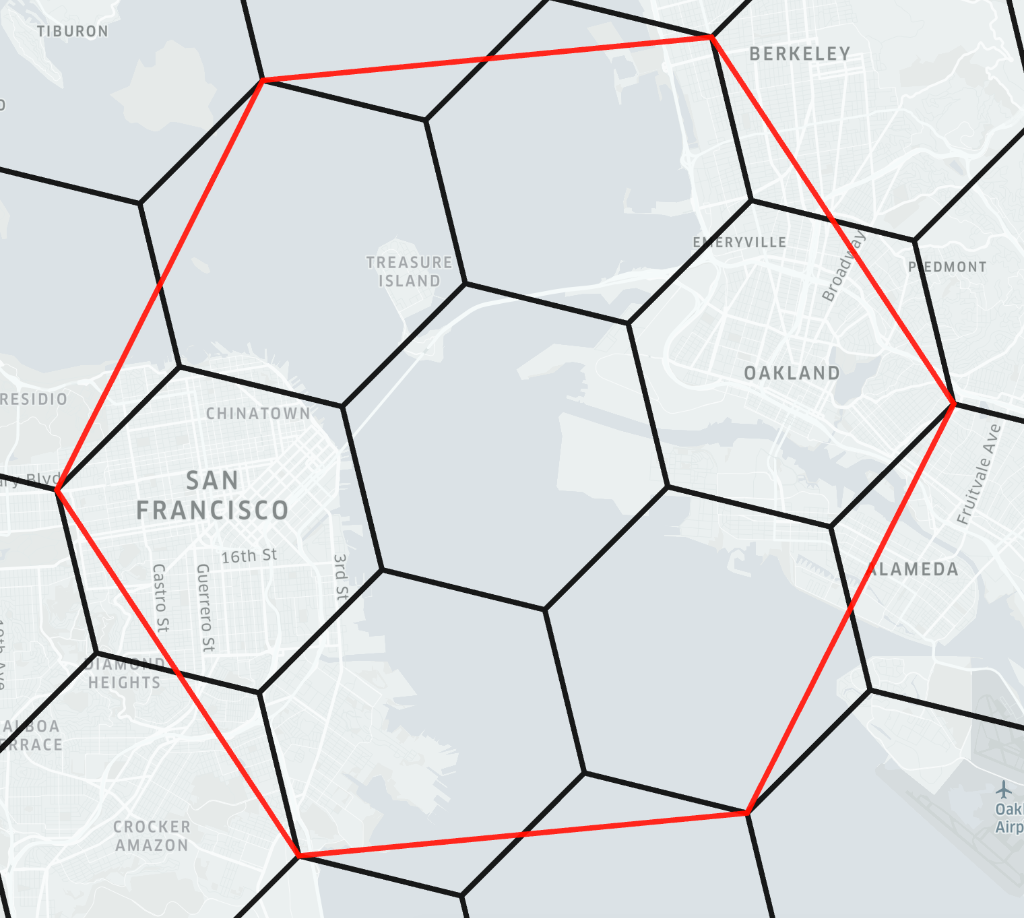
H3 is a hierarchical hexagonal grid system. Each cell at resolution r has 7 children at resolution r+1:
- 1 center child (position 0)
- 6 edge children (positions 1-6)
Faces
A face is a boundary edge of a hexagonal cell. Each hexagon has 6 faces, numbered 1-6.
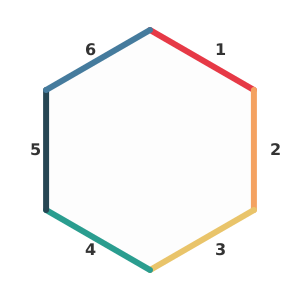
Note: The face numbering follows H3's internal child position convention, not geographic direction.
Boundary Tracing
When a child cell is positioned at the edge of its parent, it "lies on" one or more of the parent's faces.
Example
A child at position 1 may lie on faces 1 and 3 of its parent (depending on resolution parity).
Face Mapping Tables
The library uses precomputed lookup tables that map:
- (resolution_parity, child_position, child_face) → parent_face
These tables differ for: - Even resolutions: Children are rotated one way - Odd resolutions: Children are rotated the opposite way - Pentagon parents: Special 5-sided cases at the 12 H3 base pentagons
Key Functions
trace_cell_to_parent_faces(h, input_faces)
Given a cell h and a set of its own faces, returns which faces of its parent those map to.
trace_cell_to_ancestor_faces(h, input_faces, res_parent)
Same as above, but traces up to any ancestor resolution.
cell_to_coarsest_ancestor_on_faces(h, input_faces)
Finds the lowest resolution ancestor where h still lies on at least one of the specified faces.
children_on_boundary_faces(parent, target_res, input_faces)
Returns all descendants at target_res that lie on the specified faces of parent.
boundary_cell_ids(parent, target_res, input_faces, sort=False)
The same descendants as a NumPy uint64 array — the fast path for large boundaries. sort=True returns them in traversal order.
boundary_cell_at(parent, target_res, n) / boundary_rank(parent, cell)
Compute the n-th boundary cell directly, and recover a cell's position, in O(depth) — without generating the rest. See Boundary Indexing.
get_buffered_boundary_polygon(cell, intermediate_res, buffer_meters)
Traces the cell's boundary, merges it and pushes the edges outward, giving one polygon that contains every descendant — which the cell's own hexagon does not, since descendants straddle it. get_buffered_h3_polygon is a cheaper approximation that does not guarantee containment. See Buffered Polygons.
Use Cases
- Spatial Filtering: Find all cells along a specific boundary of a region.
- Hierarchical Routing: Optimize path-finding by focusing on boundary cells.
- Visualization: Highlight which parts of a cell touch its parent's edge.