Junctions, zebras and sidewalks
Lanes stop where a junction begins; painted crossings and tagged sidewalks are drawn, nothing is guessed.
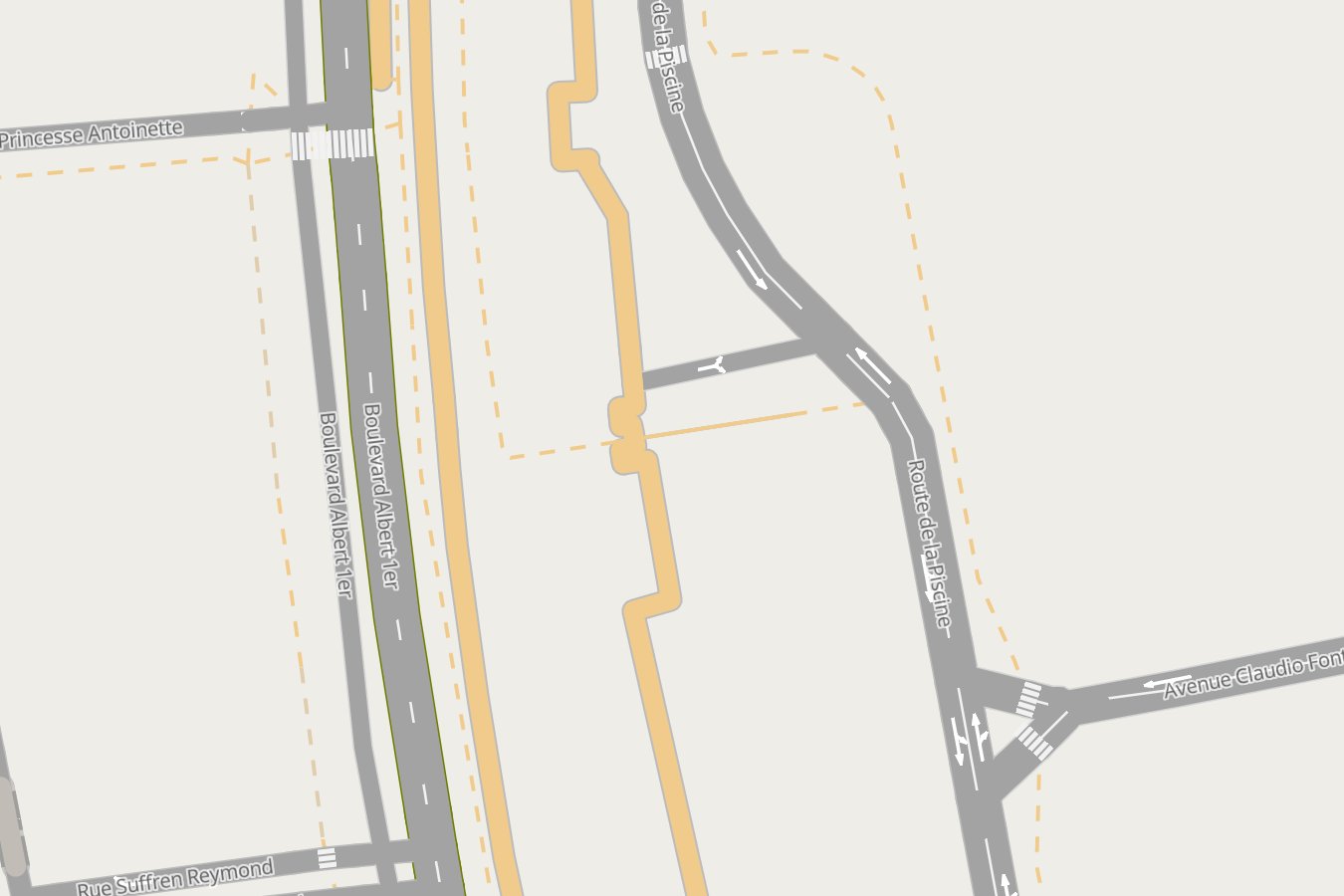
Junctions
A junction is plain, as on a real road: the lanes, their lines and arrows stop where it begins, and the road surface goes on through it. Where it begins is SUMO's (duckOSM's GMNS export cuts each lane there); the lane stays on duckOSM's own line, so it never jumps sideways. Where a lane goes on straight into the lane of the next road (a road that splits into two, two that merge), the two lane lines meet: duckOSM bends the narrower road's lane to its place in the wider one.
The connectors (SUMO's paths from lane to lane through a junction) are not drawn: lane_page(...,
connectors=True) adds them unseen, for a page that highlights routes.
Zebras
A crossing duckOSM calls painted (OSM crossing=marked / zebra, crossing:markings) is white stripes
across the road it crosses: zebra.stripe_m (0.5 m) wide, zebra.gap_m apart, as long as the crossing is
wide, from zoom 17. The stripes are the street's own items: a bridge over the street covers them.
An unmarked crossing shows only its footway.
Sidewalks
A sidewalk mapped as its own way (footway=sidewalk) is drawn by roadstyle like any footway. A sidewalk
only in a street's tags (sidewalk=left, right or both) is a strip in the walk colour just outside
the street, on that side of the OSM way, as wide as sidewalk:width (else sidewalk.width_m, 2 m), from
zoom 17; it stops where the street's lanes stop. sidewalk=separate, no, a bare yes and no tag add
nothing.